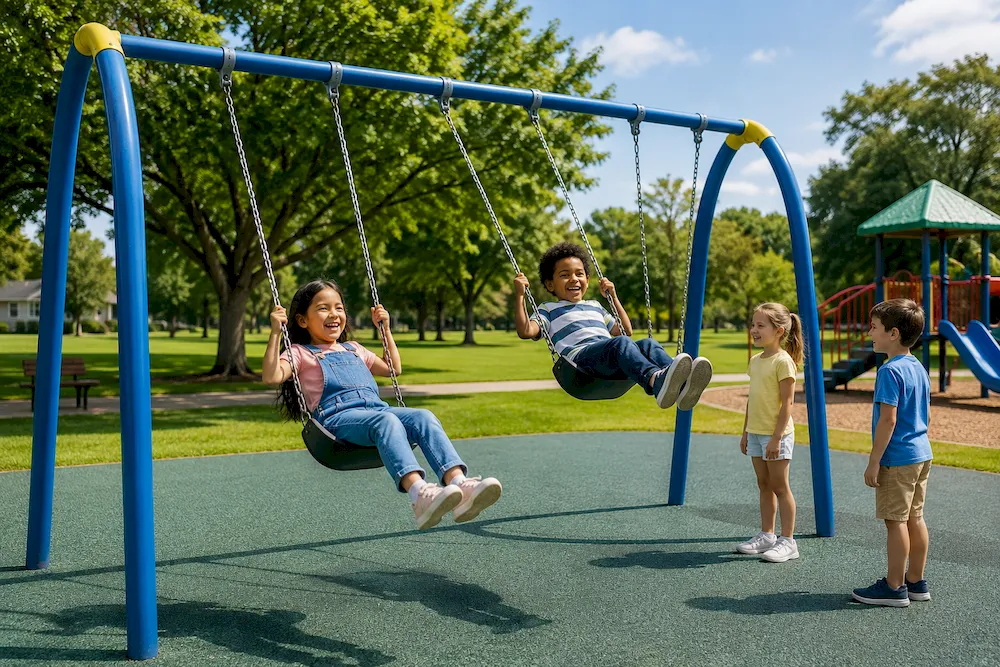
A kid swing is one of the most common items in an outdoor play area. It is simple, easy to understand, and suitable for many children. You can see swings in schools, parks, communities, kindergartens, backyards, and public playgrounds.
Although a swing looks simple, it can bring many benefits to children. It helps children move their bodies, build balance, improve coordination, and enjoy outdoor play. For playground owners, a kid swing is also a practical choice because it can fit many types of outdoor projects.
This article explains the main benefits of installing a kid swing in outdoor play areas. It can help schools, park planners, contractors, distributors, and families understand why swings are still an important part of playground design.
1. A Kid Swing Encourages Outdoor Activity
Many children spend a lot of time indoors. They may use phones, tablets, computers, or watch TV for long hours. Outdoor play gives children a chance to move, breathe fresh air, and use their bodies.
A kid swing is a simple way to encourage children to go outside. Children usually understand how to use a swing quickly. They can sit down, hold the chains or ropes, and start moving. This makes the swing easy for children to enjoy.
Why Outdoor Activity Matters
Outdoor activity helps children stay active. It also gives them time away from screens. When children use swings, slides, climbing frames, and other playground equipment, they move in different ways. This supports daily physical activity.
For schools and communities, adding swings can make outdoor spaces more useful. A play area with swings can attract more children and families.
2. A Swing Helps Children Build Balance
Balance is important for children. They use balance when they walk, run, climb, jump, and play sports. Swinging can help children practice balance in a natural way.
When a child sits on a swing, the body moves forward and backward. The child needs to control the body position. They may lean back, lean forward, or use their legs to help the swing move. These small movements help the child learn body control.
Body Control During Swinging
During swinging, children use their core muscles, arms, and legs. They also learn how their body reacts to movement. Over time, this can help improve balance and coordination.
This is one reason why swings are useful in schools and playgrounds. They are not only for fun. They also support movement development.
3. A Kid Swing Supports Coordination
Coordination means using different body parts together. When children swing, they need to hold the chains, move their legs, and control their body at the same time. This can help them improve coordination.
At first, some children need help from adults. They may need someone to push them. Later, they learn how to pump their legs and swing by themselves. This process helps children understand timing and body movement.
Simple Movement Skills
- Holding the swing chains or ropes
- Sitting in the correct position
- Moving legs forward and backward
- Leaning the body at the right time
- Stopping the swing safely
These are basic movement skills, but they are useful for children. Swinging can help children practice these skills again and again.
4. A Swing Can Help Children Gain Confidence
Many children feel happy when they learn to swing by themselves. At first, they may need help from parents, teachers, or other adults. After some practice, they can control the swing on their own.
This gives children a sense of progress. They learn that they can try, practice, and improve. This kind of experience can build confidence.
From Assisted Play to Independent Play
For younger children, adults may push the swing slowly. As children grow, they can try to move the swing by themselves. This change from assisted play to independent play is important.
It helps children feel more capable. It also gives them a safe way to take small challenges in outdoor play.
5. Swings Are Easy for Children to Understand
Some playground equipment may need more explanation. A child may need to learn how to use climbing nets, fitness bars, or complex play structures. But a kid swing is easy to understand.
Most children know what a swing is. Even if they have never used one before, they can learn quickly with adult guidance. This makes swings suitable for many play areas.
Good for Different Outdoor Spaces
A kid swing can be used in many places, such as:
- School playgrounds
- Kindergartens
- Public parks
- Community play areas
- Backyards
- Resorts and campsites
- Commercial outdoor play spaces
Because the function is simple, swings are easy to include in different playground plans.
6. A Swing Adds More Play Value to the Playground
A good playground should offer different types of play. Some children like slides. Some like climbing. Some like swings. If a playground only has one type of equipment, children may lose interest faster.
Adding a kid swing can make the play area more complete. It gives children another way to move and play. It can also help distribute children across the playground, so not everyone uses the same equipment at the same time.
Common Playground Combinations
- Kid swing + slide
- Kid swing + climbing frame
- Kid swing + play set
- Kid swing + outdoor fitness equipment
- Kid swing + sand play area
- Kid swing + balance equipment
For schools and parks, this kind of combination can make the playground more useful for different age groups.
7. Swings Support Social Play
A swing can also support social play. Children often wait for their turn, talk with friends, ask for help, or play together near the swing area.
This gives children chances to practice simple social skills. They may learn to wait, share, communicate, and follow rules. These skills are useful in school and daily life.
Examples of Social Skills
- Waiting for a turn
- Asking another child to share
- Helping a friend start swinging
- Following safety rules
- Playing near others with care
For teachers and parents, swings can create natural chances to guide children in group play.
8. A Kid Swing Can Fit Small or Large Spaces
Another benefit of a kid swing is flexibility. A swing can be part of a large playground, or it can be used in a smaller outdoor area.
For a backyard, one or two swing seats may be enough. For a school or park, a larger swing frame can include several swing seats for more children. The design can be adjusted based on the space.
Space Planning for Swings
When planning a swing area, the equipment size is not the only thing to consider. You also need enough space in front and behind the swing. Children move forward and backward while swinging, so the safety area is important.
Before installation, check the following:
- Total width of the swing frame
- Height of the swing frame
- Safety space in front and behind
- Distance from other playground equipment
- Ground surface condition
- Visibility for adults or supervisors
9. Swings Can Be Made with Different Materials
Kid swings can be made with different materials. The frame may be wood or metal. The seat may be rubber, plastic, belt-style material, or other safe materials. The chains or ropes should be strong and suitable for outdoor use.
Wooden Swing Sets
Wooden swing sets are often used in backyards, parks, and natural-style playgrounds. They can match green spaces and outdoor landscapes. But wood needs regular maintenance to prevent cracks, rot, or loose parts.
Metal Swing Frames
Metal swing frames are often used in schools, parks, and public playgrounds. They are strong and suitable for frequent use. The metal surface should have anti-rust treatment for outdoor use.
Swing Seats
Swing seats should match the age of the users. Younger children may need bucket seats or seats with more support. Older children can use belt seats or flat seats. The seat should be comfortable to hold and safe to use.
10. A Kid Swing Is Easy to Maintain
Compared with some complex playground equipment, a swing is usually easier to inspect and maintain. The main parts are the frame, swing hangers, chains or ropes, seats, connectors, and ground anchors.
Regular checks are still important. A swing is used with repeated movement, so some parts may become loose or worn over time.
Basic Maintenance Checklist
- Check if the frame is stable
- Check bolts and connectors
- Check chains or ropes
- Check swing hangers
- Check seats for damage
- Check the ground surface
- Repair or replace damaged parts in time
For public playgrounds and schools, maintenance should be done on a regular schedule. This helps keep the swing area safe for daily use.
11. Swings Are Suitable for Many Age Groups
Swings can be designed for different age groups. This makes them useful in many playground projects.
For Toddlers
Young children need seats with more support. Bucket seats or enclosed seats can help them sit more safely. Adult supervision is always needed.
For Preschool Children
Preschool children may use small belt seats or supportive seats, depending on their ability. The swing height should be suitable for their age.
For Older Children
Older children can usually use standard swing seats. They may enjoy higher movement and more independent play. The swing frame should be strong enough for frequent use.
12. Swings Help Improve the User Experience of a Playground
A playground should be easy to use and enjoyable for children. Swings can improve the overall user experience because they are familiar and popular. Many children go directly to the swing area when they arrive at a playground.
For public parks and communities, adding swings can increase the value of the outdoor space. Families may stay longer when children have more activities to choose from.
Why Playground Owners Choose Swings
- Children understand them easily
- They work in many spaces
- They support active play
- They can be combined with other equipment
- They are suitable for many playground projects
Conclusion
A kid swing is a useful part of outdoor play areas. It supports outdoor activity, balance, coordination, confidence, and social play. It is also easy for children to understand and can fit many types of playground projects.
For schools, swings can help children move during breaks and outdoor activities. For parks and communities, swings can make public spaces more attractive for families. For backyards, swings can give children a simple way to play outside at home.
When choosing a kid swing, consider the age group, space, material, safety area, installation, and maintenance. A well-planned swing area can serve children for a long time and add value to the whole playground project.